How to Write an SEO Content Brief in 2026

Most “how to write a content brief” guides were written by people who haven’t checked the SERPs in two years. They tell you to “research your competitors” and “consider search intent” without saying what either of those things actually mean in 2026. The result is briefs that read fine and rank for nothing, and that’s the common outcome rather than the exception: an Ahrefs study of around 14 billion pages found that 96.55% of content gets no traffic from Google at all.
A content brief in 2026 has one job: tell the writer exactly enough about the live ranking landscape that they can produce a piece that belongs in the top 10. Everything else (the tone notes, the persona doc, the “voice of the brand” paragraph) is downstream of that single requirement.
What a content brief is (and what it isn’t)
A content brief is the strategic document a writer reads before they start writing. It carries the research, the audience, the differentiation angle, the structural map, and the SEO targets. It is not the article. It is not the outline by itself. And it is not a Slack message that says “write something on email marketing tools by Friday, ~2000 words.”
A good brief contains everything the writer needs to make a single decision: what to put in this article, in what order, for what reader, in what tone, against which competitors. If the writer has to ask you a single research question, the brief failed.
A bad brief is a keyword and a word count. We’ve all sent them and we’ve all gotten back the predictable result: a generic article that ranks page 4 and converts no one. Page 4 might as well not exist: a Backlinko analysis of 4 million Google results found that only 0.63% of searchers click anything on page two, while the top three results take 54.4% of all clicks.
Why the brief comes before the outline, not after
The outline is a structural artifact. It says: H2, H2, H3, H2, H3, H3. It belongs inside the brief, not as a separate prior step.
The reason matters. If you build the outline first, you’re committing to a structure before you’ve read what’s currently ranking. You’re guessing at intent. You’re picking section headings based on what feels comprehensive instead of what Google’s already rewarding for this keyword. The outline becomes a constraint that pulls the rest of the brief out of alignment with the live SERP.
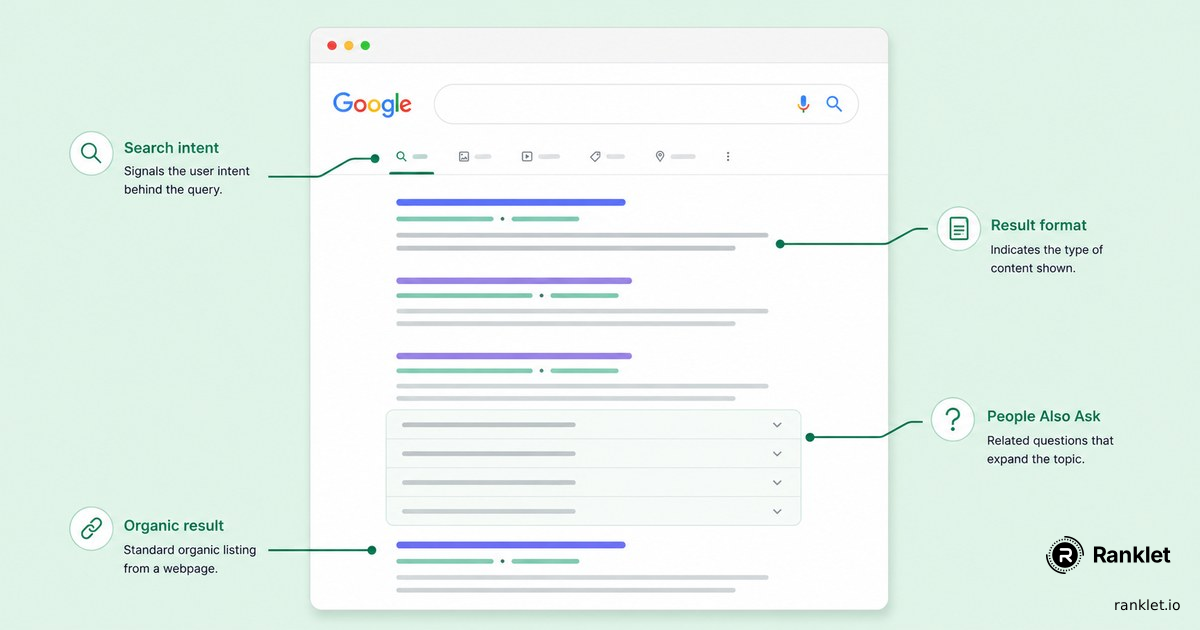
The right order is research first (search intent, content format, ranking length, People Also Ask, related searches), and then the outline drops out of the research almost on its own. The H2s aren’t invented. They’re surfaced. The difference between briefs that produce ranking content and briefs that don’t is almost always at this step.
Step 1: Identify search intent from the live top 10
Open an incognito tab. Search the keyword. Read the first ten URLs, not the meta titles. The actual content.
You’re looking for one thing: what does Google think the searcher wants? If the top 10 is dominated by listicles, the intent is comparison. If it’s split between product pages and informational guides, the intent is mixed and the brief needs to call that out. If half the results are video, you have a format problem that no amount of text optimisation will fix.
Intent isn’t a label you stamp on the brief and move past. It’s the entire reason every other decision in the brief gets made. A how-to keyword with strong commercial intent (the searcher is comparing tools while learning) needs a brief that explicitly says so. Otherwise you’ll get a pure tutorial that bounces because it doesn’t address the buying decision the searcher is half-making.
For more on this: SERP analysis is how you read intent signals before you write.
Step 2: Set word count from median ranking length
Forget round numbers. “1500–2000 words” is a guess. “2,300 words, calibrated from the median of the current top 10 with the longest and shortest results excluded as outliers” is a target.
The median is the right anchor. The mean gets pulled by one absurd 12,000-word pillar that someone wrote in 2019 and hasn’t updated. The median tells you what’s actually competitive at this word count for this keyword today. Anything dramatically longer probably overdoes it. Anything dramatically shorter probably can’t compete on coverage.
Word count is not a ranking factor. It’s a coverage proxy. Google rewards content that fully addresses what the searcher needs. The median length of the top 10 is the best public signal we have about what “fully addresses” looks like for that specific query. It’s also rarely the length a style guide would pick: Orbit Media’s 2026 survey of 1,042 content marketers puts the average blog post at 1,312 words, well short of the 2,800-word median in the worked example below.
Step 3: Map People Also Ask into your H2/H3 structure
People Also Ask is the most underused signal in any brief. The four to eight questions Google surfaces under the top result are not random. They’re the questions Google’s models believe the searcher is likely to want answered next. Each one is a candidate H2 or H3.
Read the cluster. Notice which questions are definitional (“what is X”), which are comparative (“X vs Y”), which are procedural (“how do I do X”). The cluster shape tells you the intent mix at the section level. A keyword with five “how do I” PAA questions and one “what is” needs a brief structured for procedural answers, not a long-winded definition section.
When you put PAA questions into the brief, don’t just paste them in. Mark each one with what it should become: H2, H3, featured-snippet target, or a paragraph inside another section. That single piece of guidance saves the writer an hour of structural guesswork.
Step 4: Name the differentiation angle before your writer starts
This is the section everyone skips and the one that does the most damage when it’s missing.
Read the top three ranking pieces. What’s the one thing they all do? What’s the one thing none of them do? The first answer tells you what your piece has to cover to compete. The second tells you what your piece has to add to win.
The differentiation angle is one sentence. “Most ranking pieces explain the four intent types; none of them explain that intent operates at the section level, which is what this piece argues.” That’s a brief that produces a piece worth ranking. “Comprehensive guide to search intent” is a brief that produces a piece that already exists eight times on page one.
If you can’t name the angle in one sentence, the brief isn’t done. The writer will then invent an angle on the fly, usually a weak one, and the article will read like every other article on the topic.
Step 5: Add E-E-A-T signals your writer can actually use
E-E-A-T (Experience, Expertise, Authority, Trust) is real, and most briefs handle it by writing “include E-E-A-T signals” as a bullet and calling it done. That bullet is useless.
What the writer needs is specific. Examples that work:
- “Cite at least one original example from a real client engagement (Experience).”
- “Reference the 2026 update to Google’s helpful content guidelines and explain what changed (Expertise + Authority).”
- “Link to the original Search Quality Rater Guidelines PDF, not a third-party summary (Trust).”
E-E-A-T signals are non-generic, sourced, first-person where appropriate, and verifiable. If your brief just says “be authoritative,” you have not given the writer the signal. You’ve given them the homework.
A worked example: brief for “best CRM for freelancers”
Abstract guidance is fine; a worked example is better. Here’s the compressed brief shape for a real keyword, demonstrating each step in action.
Step 1, intent from the live top 10. The current top 10 is 9 listicles and 1 vendor product page. PAA cluster is dominated by “what is the best CRM for freelancers” and “do freelancers need a CRM.” Intent: 70% commercial-investigation (people comparing), 25% informational (people wondering if they need one at all), 5% transactional (people ready to sign up). Brief flag: dominant commercial, but the informational sub-intent is large enough that the article needs a “do you actually need one” section, not just a comparison.
Step 2, word count from median. Top 10 word counts cluster around 2,200–3,400. Median sits at 2,800. Target: 2,500–3,000.
Step 3, PAA into structure. Six relevant PAA questions surface. Three become H2s (“what is the best CRM for freelancers,” “do freelancers need a CRM,” “how much does a CRM cost for a freelancer”). Two become H3s under the comparison H2. One becomes a featured-snippet target: the “how much does a CRM cost” question, answered with a structured table.
Step 4, differentiation angle. Top three ranking pieces all rank tools the same way: features, price, integrations. None of them rank by what freelancers actually need (lightweight, low-maintenance, easy export when client work moves). Angle: “We rank these CRMs by how little setup time they cost a freelancer who hates admin, not by feature count.”
Step 5, E-E-A-T signals. Specific: “Cite at least one CRM the author has personally used and abandoned, and explain why. Reference the 2025 freelancer-tooling survey from Indy if available. Avoid vendor sponsorship language.”
That’s a brief in five steps. The next steps (title options, meta description, full outline with section guidance) drop out almost mechanically once the first five are nailed.
The 12 sections every production brief should have
After running this process across hundreds of briefs, the same 12 sections show up every time. Skip one and the writer fills in the gap with a guess.
- Search intent, labelled with intent type and a one-line explanation of what the searcher actually wants.
- Content type: listicle, guide, comparison, tutorial, template, tool page. Pulled from the dominant format in the top 10.
- Word count range, calibrated from the median length of the current top 10, with a soft floor and ceiling.
- Target audience: primary persona plus the pain points they bring to this specific search.
- Tone and voice, sized to the audience. Friendly for top-of-funnel, more direct for bottom.
- Differentiation angle. One sentence. What this piece adds that the current top 10 doesn’t.
- Title suggestions: three options, each with the primary keyword and a click-intent hook.
- Meta description, under 160 characters, written, not “to be added later.”
- Featured snippet target: format (paragraph, list, table) and the exact question the snippet should answer.
- Full outline: H2s and H3s with a sentence of guidance under each so the writer knows the point.
- E-E-A-T signals. Specific, sourced, non-generic.
- Keywords and questions: primary and secondary keywords to thread through, plus the People Also Ask questions to address.
That’s the format we settled on at Ranklet (see how Ranklet generates a 12-section brief in under 30 seconds), but you can build the same shape by hand if you have a few hours per brief to spare.
What separates a 12-section brief from a 4-section brief
You can get most of the way to a usable brief with four sections: keyword, intent, audience, outline. That’s the shape most “brief templates” online land on. The reason we settled on twelve isn’t completeness for its own sake; it’s that the four-section shape silently dumps the missing work onto the writer.
Four-section briefs make the writer invent: the tone, the differentiation angle, the meta description, the title options, the featured snippet target, the E-E-A-T signal sourcing, the per-section reading shape. Those decisions get made under writing pressure and they get made on autopilot. A writer staring at a blank doc has to pick a title; they’ll pick the obvious one. Has to write a meta description; they’ll write a generic one. Has to find an angle; they’ll default to “comprehensive guide on X.”
The 12-section brief moves those decisions to the brief-writer, who’s not under writing pressure and can take ten extra minutes to make each one well. The writer then executes against decisions that were made deliberately rather than improvised in the moment.
The number isn’t sacred. The principle is: every strategic decision should be made before the draft starts, not during it.
How to hand off a brief to a freelance writer
A good handoff is short. It assumes the brief speaks for itself. The cover note should contain three things:
- The deadline, in your timezone, with an actual date.
- The one thing that would make you reject the draft. Be specific: “if the differentiation angle isn’t clearly visible in the intro, I’ll send it back.”
- A single sentence about anything in the brief that isn’t standard. (“Note the intent is mixed, so this needs a commercial section, not just a tutorial.”)
That’s it. No 800-word context dump. No “let me know if you have any questions.” A brief that needs an explanatory Loom video isn’t a brief. It’s a meeting waiting to happen.
Questions that keep coming up
How long should a content brief be?
Long enough to carry every decision, and no longer. In practice that’s one to two pages: the twelve sections above, with a sentence of guidance under each outline heading. A brief that runs past three pages has usually started writing the article, which takes the work, and the voice, away from the writer.
How long does it take to write a content brief by hand?
Two to three hours if you do the research properly: reading the live top 10, counting words for the median, mapping People Also Ask and naming the angle. That’s close to the time the draft itself takes, since Orbit Media’s 2026 survey puts the average blog post at 3 hours 20 minutes to write. It’s the reason briefs get skipped, and the reason a skipped brief costs more than the time it saves.
Who should write the brief, the strategist or the writer?
Whoever owns the ranking outcome, which is usually the editor or strategist. The point of the brief is to make the strategic decisions away from the pressure of drafting. A writer can brief their own piece, but only if they do it as a separate step, before the first sentence is written.
Do content briefs still matter when AI answers the question directly?
More than before, because the brief is where you plan for citation as well as ranking. AI answers quote passages: an answer-first opening, figures with named sources, question headings that match what people ask. Those need to be decided in the brief, not retrofitted after publishing. We cover what actually gets a page cited in why your content isn’t showing up in AI search.
Brief template, copy and fill in
Here’s a stripped-down version you can use today. Fill in everything; if a field doesn’t apply, write “n/a”, never blank.
Keyword:
Search intent:
Content type:
Word count range:
Target audience:
Tone:
Differentiation angle (one sentence):
Title options:
  1.
  2.
  3.
Meta description (≤160 chars):
Featured snippet target — format and question:
Outline:
  H2:
    H3:
    H3:
  H2:
    H3:
E-E-A-T signals (specific, sourced):
Primary keyword:
Secondary keywords:
People Also Ask questions to address:
  -
  -
Fill that in for every brief and the floor quality of your content moves immediately. Writers stop guessing, structure stops drifting, and the SERP-grounded research starts showing up in the rankings.
If you’d rather not maintain a 12-section template by hand for every piece, generate your first brief free. Ranklet pulls live SERPs at generation time and produces the same structure end-to-end. Three free briefs per month, no credit card.
Related reading
What Is SERP Analysis (And Why It Shapes Every Brief)
SERP analysis tells you what Google thinks ranks for your keyword. Here's what it covers, why most briefs skip it, and how to do it without a pricey suite.

Content Briefs vs Content Outlines: What's the Difference
A brief and an outline aren't the same document. Here's exactly what each one does, why you need both, and what belongs in which.

Search Intent: The Part Most Briefs Get Wrong
Most briefs label intent and move on. Here's why that's backwards, and how matching intent at the section level is what actually moves rankings.