What Is SERP Analysis (And Why It Shapes Every Brief)
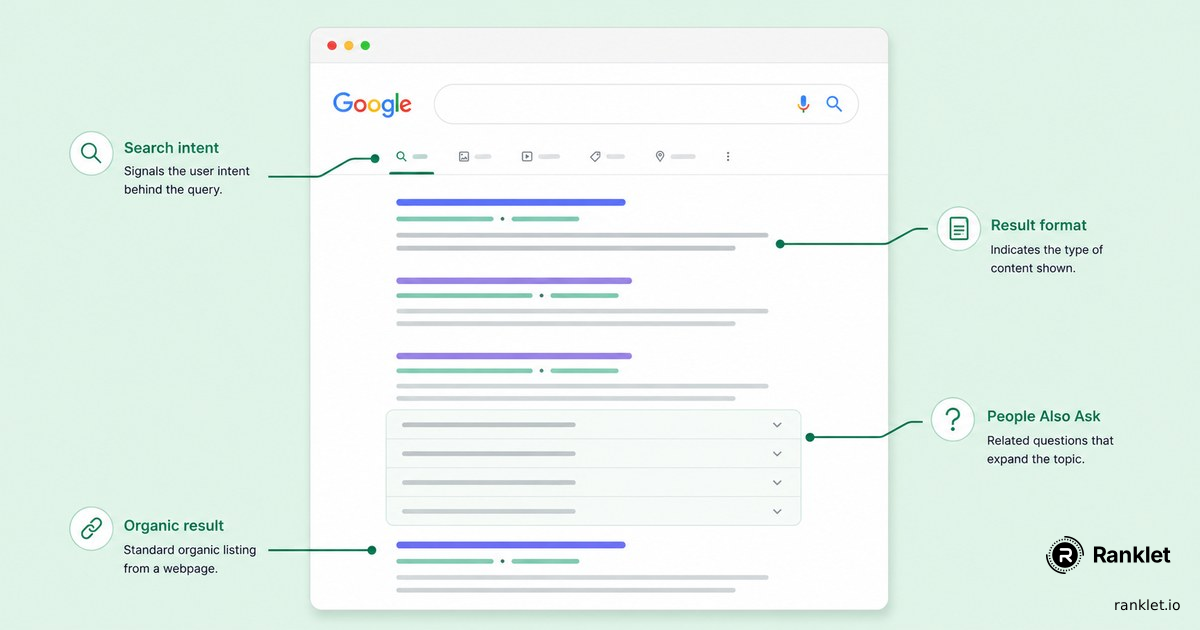
SERP analysis sounds like a thing you need a $400/month platform to do. It isn’t. The vendors have an incentive to make it sound like one; they’re selling the dashboards. But 80% of what you actually need to know to write a brief that ranks can be read directly off the first page of Google by anyone with an incognito window and twenty minutes.
This post is the mental model, not the software dependency. If you understand what SERP analysis is actually for, you can do it with your eyes; if you understand what it’s actually for and want the time back, you can automate it.
What SERP analysis actually means (not the vendor pitch version)
SERP analysis is the process of reading the first page of Google results for a keyword and extracting the signals Google is publicly broadcasting about what content ranks for that query.
That’s it. Strip the marketing copy and that’s the whole thing.
The signals are there in plain text. Intent type, content format, median ranking length, the People Also Ask cluster, the related searches, the meta titles that won the click. They’re not hidden behind an API. The API just packages them.
The reason this matters is that everything downstream of a content brief (outline, word count, angle, audience tone) should be answering signals from the live SERP, not from a 2022 SEO course or whatever someone tweeted last week. If your brief isn’t grounded in the current top 10, you’re optimising for a SERP that doesn’t exist anymore. And the first page is where the clicks are: a Backlinko analysis of 4 million Google results found that the top three results take 54.4% of all clicks.
The five signals that change how you write a piece
Five signals do almost all the work. If you read these five well, you’re 80% of the way to a brief that produces ranking content.
- Search intent. What does the searcher actually want? Informational, commercial, transactional, navigational, or some mixture.
- Content format. What shape of content is winning? Listicle, guide, tutorial, comparison table, tool page, video.
- Median word count. What’s the realistic coverage target? The middle of the top 10, not the longest result.
- People Also Ask cluster. What sub-questions does Google think the searcher will want answered next?
- Related searches. What adjacent intents and keyword clusters share the SERP with this one?
Every other signal is interesting. These five are load-bearing. If a brief tool gives you these five with current data, it covers most of what matters. If it doesn’t, the dashboard is decorative.
One element has joined page one since most SERP guides were written: the AI Overview. In a Pew Research Center study of 68,879 Google searches, 18% produced an AI summary, and people who saw one clicked a traditional result in 8% of visits, against 15% when there was none. When the SERP you’re reading has an AI Overview, read it like any other result: what does it answer, and which pages does it quote?
Don’t assume those are the top 10. An Ahrefs study of 863,000 keyword results found that 38% of AI Overview citations come from pages in Google’s top 10, so the pages an AI answer quotes are a separate list worth noting in the brief.
How to read search intent from page-one results
Open the keyword in incognito. Look at what the first ten results actually are. Don’t read the meta descriptions; click in.
If eight of the ten are listicle-style “10 best X” pages, the intent is commercial-investigation: the searcher is comparing options. If six are how-to guides with the keyword in an H2 like “How to do X in N steps,” the intent is informational-procedural. If you see a mix (say, four product pages from vendors plus six guides), the intent is mixed, and the brief needs to call that out as a structural challenge.
There’s a small set of signals you can read without going past the SERP page itself:
- Are there shopping ads? Strong commercial intent.
- Is there a knowledge panel pulling from Wikipedia? Probably informational, definitional intent.
- Is there a featured snippet that’s just a paragraph definition? Definitional intent leads the page.
- Is there a video carousel? Some portion of the searchers prefer video format, and your brief should at minimum acknowledge that.
The full search-intent angle, including why intent operates at the section level, is its own topic. For SERP analysis purposes, you only need to be confident about the dominant intent and any secondary intent that’s also present.
Understanding content format signals (listicle vs guide vs tool page)
Format is a signal most briefs collapse into “content type” and then ignore.
Look at what’s actually ranking, not what the H1 says. A “complete guide to email marketing tools” might in fact be a listicle masquerading as a guide. Click in and skim. Listicle → “10 best email marketing tools” with numbered sections, each tool getting a similar structural slot. Guide → linear prose, sections building on each other, no parallel structure. Tool page → a calculator, a checker, an interactive widget.
If the top 10 is dominated by one format, your piece needs to compete on that format. Trying to win a SERP dominated by listicles with a 4,000-word linear guide is fighting against the format gravity Google has already established for that query. You can sometimes win it with exceptional content, but you’re starting from a structural disadvantage.
Listicles are the most common “what is actually ranking” surprise. People search “how to do X” expecting a how-to article and find the SERP is half listicles. That tells you the searcher actually wants comparison or alternatives, not a single procedural answer.
Why word count targets should come from the SERP, not a style guide
Word count is a coverage proxy. It is not a ranking factor in itself. Google does not have a “more words is better” weight in its ranking model.
But coverage matters, and the median word count of the current top 10 is the best public signal we have for “how much coverage does Google currently consider competitive for this query.” Aim for the median, plus or minus 20%. Ignore the longest outlier. There’s almost always one 10,000-word pillar from 2019 that pulls the mean up by 40% and that nobody is rewarding for that length specifically.
The fastest way to do this manually: copy each top-10 URL into a word counter, list the counts, sort them, take the middle value. That’s your target. If you don’t have time for that, the median for most informational SEO keywords sits between 1,500 and 2,800 words. Commercial-investigation keywords (listicles, comparisons) skew higher, often 2,800 to 4,000. Transactional keywords skew lower, often 800 to 1,500.
Ranklet runs this analysis automatically at brief generation time, and every brief includes a calibrated word count range pulled from the current top 10. You can do it by hand in fifteen minutes if you want to.
People Also Ask: what it tells you about searcher sub-intent
The PAA box is the part of the SERP everyone notices and almost no one uses well.
The four to eight questions that surface under (or near) the top result are not random selections from a question dataset. They are the queries Google’s models predict the searcher is likely to ask next, given the original query. That’s a sub-intent signal, and it tells you the structural decomposition Google expects of comprehensive content on this topic.
Read the cluster. Notice the shape:
- A cluster heavy on “what is” and “definition” questions tells you the topic still needs definitional grounding for most searchers.
- A cluster heavy on “how to” and “step” questions tells you the topic is past the definitional stage and procedural answers carry the weight.
- A cluster heavy on “best” and “vs” questions tells you commercial sub-intent is mixed in even if the primary intent looks informational.
Each PAA question is a candidate H2 or H3 for your brief. Some belong as featured-snippet targets: direct, structured, one-paragraph answers. Some belong as sub-sections inside a larger H2. The decision is judgement, but the source list is right there in the SERP.
Related searches: the keyword clusters hiding in plain sight
The “related searches” block at the bottom of Google’s first page is the SERP signal almost everyone forgets. It’s the keyword cluster Google thinks shares thematic ground with your query.
Two things to extract from it:
-
Adjacent intents. If you searched “email marketing tools” and the related searches include “email marketing for small business” and “email marketing automation,” those are intent variants of the same head term. Your piece may want to address them as sections, or you may decide they’re separate articles, but you needed to make that decision consciously, not by accident.
-
Secondary keywords. The exact phrasing in the related searches is a free secondary-keyword list. Drop it into your brief under “secondary keywords to thread through.” Writers will naturally weave them in without you having to brief individual phrases.
How to run a manual SERP analysis in under 20 minutes
Here’s the strip-down. Twenty minutes, no tools beyond your browser.
- Open the keyword in incognito (or a logged-out browser to avoid personalisation skew). Two minutes.
- Read the top 10. Actually click in, don’t just read meta titles. Six minutes (~36 seconds per result).
- For each result, note: format (listicle / guide / tool / etc.), approximate word count, and one defining feature of how it covers the topic. Five minutes.
- Copy the PAA questions. Read them for sub-intent shape. Two minutes.
- Copy the related searches. Three minutes.
- Synthesise: dominant intent, dominant format, median word count, PAA cluster shape, secondary keyword list. Two minutes.
You’ll get faster. The first time takes thirty. The fifth time takes fifteen.
If you want this in under 30 seconds instead of 20 minutes, that’s what Ranklet does, and the rest of the brief drops out of it automatically. Try a live SERP-grounded brief free: three briefs per month, no credit card.
What changes when you start reading SERPs this way
The shift in how briefs read once they’re SERP-grounded is sharper than people expect. Two specific things happen, and both feed back into the writing.
Writers stop arguing with the brief. When the brief says “intent is commercial-investigation, target word count 2,800, format is listicle,” and the writer can pull up the live top 10 and see eight listicles at roughly 2,800 words, the brief is no longer an opinion. It’s an observation. The “should this be a guide instead?” conversation doesn’t happen because the SERP has already answered the question.
The differentiation angle stops being generic. A brief that calls the angle “comprehensive guide to email marketing tools” reads fine until you put the live top 10 next to it and realise eight of them already are comprehensive guides to email marketing tools. The angle has to be specifically not-that. Once you’ve read the SERP, the generic angles disqualify themselves because you can see exactly which articles already exist with that angle.
The downstream effect: articles get more opinionated, more specific, and more clearly different from each other. That’s the part that compounds in rankings over a quarter.
What SERP analysis can’t tell you
It’s worth naming the limits. SERP analysis tells you what Google is currently rewarding. It does not tell you:
- Whether your audience is the same as the audience Google is showing the top 10 to. A B2B SaaS keyword whose top 10 is dominated by content-marketing-style listicles might still have a serious enterprise audience underneath that you can serve better with a different format.
- Whether the topic is worth covering at all. SERP analysis tells you how to win the ranking; it doesn’t tell you whether the ranking is worth winning for your business.
- What’s coming next. SERPs are a snapshot. Major core updates can re-cut the top 10 in a week, and the new shape may differ substantially from the old one.
These are decisions that require judgement on top of the SERP read, not instead of it. The SERP read is the floor; the judgement is what you bring.
When to re-run analysis (and when the brief is still good)
SERPs drift. The median word count for a query in January is not the median in August. Intent shifts. PAA clusters get re-cut.
But not constantly. The practical rule:
- Same brief still works if: the article hasn’t been published yet and less than 60 days have passed since brief generation. Most SERPs don’t shift enough in two months to matter.
- Re-run analysis if: you’re updating an existing article that’s slipped in rankings; the keyword is in a fast-moving niche (AI, crypto, anything where Google’s quality bar is actively being tuned); or more than 90 days have passed.
- Always re-run if: Google announced a core update in the last 30 days. Core updates re-cut SERPs more than people think.
The signals are public. The hard work is the interpretation, and the interpretation is the part of the brief that decides whether the article ranks. If you build that habit, the rest of the brief-writing workflow follows naturally from what you already see on page one.
Questions that keep coming up
What’s the difference between SERP analysis and keyword research?
Keyword research decides which query to target: volume, difficulty, relevance to your business. SERP analysis starts after that decision and asks what it takes to rank for the query you picked: the intent, format, length and sub-questions Google is rewarding right now. You need both, in that order.
How many results should a SERP analysis cover?
The top 10, read properly. Page two adds little, because almost nobody goes there: the same Backlinko data shows 0.63% of searchers clicking anything on it. Ten results read in full beat thirty skimmed by meta title.
Do you need a paid tool to do SERP analysis?
No. Everything in this post can be read off the live page in an incognito window. Tools save the time, not the thinking: they collect the same signals faster, and the interpretation is still yours.
Does SERP analysis still work when an AI Overview sits on top?
Yes, with one more thing to read. The organic results still tell you intent, format and length. The AI Overview tells you which question Google thinks needs a direct answer and which pages it trusts to give it, which is exactly what an answer-first opening in your brief should target.
Related reading

How to Write an SEO Content Brief in 2026
A complete guide to writing SEO content briefs that actually help writers rank, from search intent to E-E-A-T signals and everything between.

Search Intent: The Part Most Briefs Get Wrong
Most briefs label intent and move on. Here's why that's backwards, and how matching intent at the section level is what actually moves rankings.

People Also Ask: The Underused Signal in Your SERPs
People Also Ask questions tell you exactly what Google thinks your reader wants answered next. Here's how to turn that signal into brief structure.