People Also Ask: The Underused Signal in Your SERPs

People Also Ask boxes get mentioned in every SEO 101 post and then ignored in every actual brief. The signal is more useful than most people treat it. Each cluster is Google publicly telling you what your reader wants answered next, and that’s a structural blueprint for your article hiding in plain sight.
Most briefs handle PAA the way they handle E-E-A-T: a line that says “consider PAA questions” and then no concrete guidance. This post is the practical version. Take a PAA cluster, turn it into outline structure, decide which questions become snippet targets, and stop leaving the signal on the table.
What People Also Ask actually is (technically and practically)
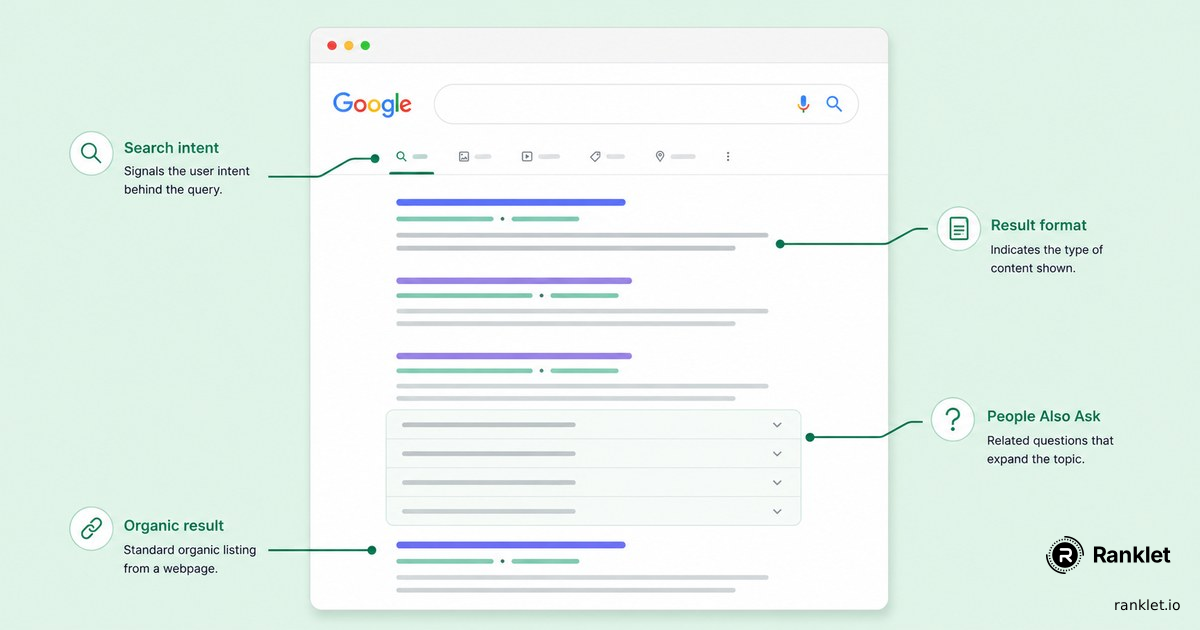
People Also Ask is the box of expandable questions Google surfaces under (or near) the top result for many queries. Each question, when clicked, reveals a short answer pulled from a ranking page, and the act of clicking often triggers Google to surface more questions, recursively, sometimes deep into a long tail.
Technically, PAA is a question-answering interface stitched onto SERPs to satisfy follow-up intent without requiring the searcher to type a second query. Practically, it’s the most under-read structural signal Google publishes.
Three things to know:
- The questions are not random. They are predicted follow-up queries based on what searchers do after the original query.
- The answers Google pulls into the expanded boxes come from ranking pages, meaning if you write a good direct answer to a PAA question on your page, you become a candidate to be that excerpt.
- PAA questions change. They re-cut based on shifting behaviour. If you re-pull a PAA cluster six months later, expect 30–50% of the questions to be different.
Why PAA is a search intent signal, not just a FAQ source
The “FAQ at the bottom” treatment is the most common misuse of PAA. People copy the questions into a Q&A block at the end of the article and call it done.
That misses the point. PAA isn’t a FAQ source. It’s an intent decomposition. Each question in the cluster tells you something about what the searcher’s mental model of the topic is and what gaps Google thinks they have.
Read the cluster shape, not the individual questions:
- Cluster heavy on “what is X.” The searcher is still in the definitional stage. The topic needs grounding before depth.
- Cluster heavy on “how do I X.” The searcher already knows what X is; they want procedure. Skip the long preamble.
- Cluster heavy on “X vs Y.” Commercial-investigation undertone. The searcher is comparing even if the query looks informational.
- Cluster heavy on “why does X.” Reader is in a troubleshooting or causal-understanding mode. Diagnostic framing wins.
The cluster gives you intent shape before you’ve even read a single ranking page. That’s the signal worth pulling out.
PAA sits inside a broader SERP analysis; the cluster is one of five major signals to read off the first page. But within that bundle, it’s the one most people skip.
How to identify the PAA cluster for your keyword
The cluster surfaces directly on the SERP. Three caveats:
- Use incognito or a logged-out window. Personalisation can pull in PAA questions that aren’t representative.
- Click into the first two or three to expand them. Often new questions surface below as a result. The “extended” cluster is more useful than the initial four.
- Stop once questions start drifting off-topic. Recursive expansion eventually wanders. Eight to twelve questions is usually the useful zone.
The cleanest approach: capture the original cluster, expand the first few, capture the secondary cluster, then stop. That gives you 8–12 questions that are tight enough to the original query to be structurally useful.
Mapping PAA questions to H2 vs H3 decisions
This is the part nobody explains and the part that does the actual work.
Each PAA question is a candidate section in your article. The decision is: H2, H3, featured-snippet target, or paragraph-inside-another-section. Use these rules:
- H2 if the question is broad enough that the answer needs more than one or two paragraphs and isn’t already covered by another planned H2.
- H3 if the question is a sub-aspect of an existing H2. (“How do I do X” is an H2; “How do I do X on a phone” is an H3 under it.)
- Featured snippet target if the question is definitional or has a clean, short, structured answer (paragraph, list, or table). These get their own H2 written specifically to win the snippet.
- Inside paragraph if the question is genuinely minor or duplicative of another section. Weave the answer in inline rather than creating a section just to answer it.
The mistake is treating every PAA question as an H2. You end up with twelve top-level sections and a page that reads as a checklist. Pick the half-dozen that genuinely deserve top-level structure and demote the rest.
PAA as a featured snippet opportunity: the position-zero path
The most under-exploited PAA play: targeting a featured snippet by writing a section explicitly designed to be excerpted.
The pattern that wins:
- Use the PAA question as the H2, verbatim or nearly so. Don’t be cute with the wording; Google’s match is more literal than people think.
- Answer the question directly in the first 40–60 words of the section. Direct, structured, no preamble.
- If the question is procedural, use a numbered list. If definitional, a paragraph. If comparative, a small table.
- Expand on the answer below, but the answerable chunk must come first and must stand alone.
The reason this works is that Google’s snippet selection looks for the cleanest extractable answer. If your page is the cleanest, you win the snippet even from a position that wouldn’t otherwise. Position zero is reachable without a top-three organic ranking (sometimes from page two) if the snippet structure is right.
When to answer PAA questions verbatim vs in your own framing
There’s a balance here. Answering every PAA question verbatim makes your page read mechanical. Re-framing every question in your own voice loses the literal-match advantage that wins snippets.
The rule:
- Use verbatim when the question is a featured-snippet target. You want the exact match.
- Re-frame when the question is becoming an H3 inside a larger section. Your H3 can be cleaner, more declarative, and more in line with the article’s voice.
- Don’t use at all when the question is essentially duplicative of another section. Answer it in passing inside the section that already exists.
Related searches vs PAA: how the two signals complement each other
PAA and related searches sit in the same SERP but signal different things.
- PAA tells you what questions the searcher wants answered next, often closely related to the original query.
- Related searches tell you what adjacent queries share thematic ground: broader, more about category, often more about intent variants than sub-questions.
For brief-writing, use both. PAA shapes your section structure. Related searches give you secondary keywords and tell you when the topic should be split into multiple articles.
If the related searches drift far from the original query, that’s a signal that the topic has natural sibling articles: pieces that aren’t subsections of your current piece but separate articles. Note them and add them to your editorial calendar. Trying to cover everything in the related-searches block in one article is how 5,000-word pieces get written that nobody reads through.
How PAA connects to intent-per-section thinking is worth reading together with this. The two signals reinforce each other when you’re deciding what each H2 should accomplish.
Putting it together: PAA-driven outline for a real keyword
Worked example. Keyword: “what is a content brief.” PAA cluster (typical at time of writing):
- What should a content brief include?
- How long should a content brief be?
- What is the difference between a content brief and a content outline?
- Who writes the content brief?
- How do you write a content brief for SEO?
- What are examples of a content brief?
From that cluster:
- “What should a content brief include?” H2, featured-snippet target. Use a numbered list. This is the kind of question where structured-list snippets win.
- “How do you write a content brief for SEO?” H2, procedural. The piece’s main how-to section.
- “What is the difference between a content brief and a content outline?” H2, comparison framing. Worth its own section.
- “What are examples of a content brief?” H3 inside the “what should it include” section, or a separate H2 if examples are detailed enough to warrant it.
- “How long should a content brief be?” H3 inside “what should it include.” Doesn’t need its own H2.
- “Who writes the content brief?” Paragraph or skipped. Rarely strong enough to be its own section unless your audience is org-design-focused.
You’ve now used the PAA cluster to shape five concrete structural decisions for the article. None of those decisions were guesses; all of them are grounded in what Google publicly says searchers want next.
Ranklet includes PAA-derived questions in every brief automatically; the cluster gets pulled at brief generation time and mapped to outline candidates. If you’d rather do it by hand, the workflow above takes about ten minutes per keyword once you’ve practiced it. Either way, stop leaving the signal on the SERP.
Related reading
What Is SERP Analysis (And Why It Shapes Every Brief)
SERP analysis tells you what Google thinks ranks for your keyword. Here's what it covers, why most briefs skip it, and how to do it without a pricey suite.

Search Intent: The Part Most Briefs Get Wrong
Most briefs label intent and move on. Here's why that's backwards, and how matching intent at the section level is what actually moves rankings.

How to Write an SEO Content Brief in 2026
A complete guide to writing SEO content briefs that actually help writers rank, from search intent to E-E-A-T signals and everything between.