How to Show Up in Google AI Overviews

Search “what is a content brief” today and you may not see ten blue links first. You’ll see a paragraph Google wrote, assembled from a few pages, with citation links to the side. That’s an AI Overview, and a Pew Research Center study of 68,879 Google searches found one on 18% of them. If your page isn’t a source behind it, you’re below the fold before the reader scrolls.
So every content team is asking the same thing: how do you get into the box? The honest answer is that you don’t optimise for the box. You optimise for the thing the box is built from, which is a clear, checkable answer to a specific question that the rest of the results already agree with. Do that well and you get pulled in. Try to game the box itself and you’ll burn a quarter chasing a format Google keeps changing.
What an AI Overview is actually made of
An AI Overview is a generated summary, but it isn’t invented out of thin air. Google builds it from pages that already rank for the query and its sub-questions, plus the People Also Ask cluster around it. The model reads those pages, finds the passages that answer the question most directly, and stitches a summary together with links back to the sources.
Two things follow from that. First, conventional ranking still helps, but it’s no longer the whole ticket. An Ahrefs study of 863,000 keyword results found that 38% of AI Overview citations now come from pages in Google’s top 10, down from about 76% in its July 2025 run, likely because the model now searches sub-questions of its own and cites what ranks for those. Reading the live SERP is still where this starts, and SERP analysis is the skill underneath all of it. Second, the unit Google selects is a passage, not a page. It doesn’t lift your whole article. It lifts the two or three sentences that answer the question cleanly. Your job is to make sure those sentences exist and are easy to find.
The uncomfortable part: the box eats your clicks
I’d be lying if I said getting cited in an AI Overview is as good as a number one ranking used to be. It isn’t. When an Overview shows, click-through on the results below it drops, sometimes a lot. In the same Pew study, people who saw an AI summary clicked a traditional result in 8% of visits, against 15% when there was none. Some of the readers who would have clicked now get their answer in the box and never leave the SERP.
That’s the trade nobody likes. Being a source in the Overview earns you a citation link and some brand exposure, but fewer clicks than the same position would have earned two years ago. The reason to care anyway is simple: the alternative is worse. If a competitor is cited and you’re not, you’ve lost the impression completely, and you’ve handed them the “according to” credibility that comes with being the named source. Reduced clicks beat zero clicks, and the audience is not small: Google reported in July 2025 that AI Overviews have over 2 billion monthly users.
What actually gets a passage pulled in
After looking at a lot of Overviews for our own queries, the pattern is boringly consistent. The passages that get lifted share a few traits.
They answer one question directly, and they do it early. A section that opens with 150 words of preamble before the answer rarely gets pulled, because the liftable part is buried. The section that opens with the answer, in two or three plain sentences, gets pulled.
They’re specific and checkable. “A content brief is a document that guides a writer” is too vague to be useful to the model. “A content brief is a one to two page document that tells a writer the target keyword, search intent, outline, and the questions to answer” is specific enough to lift and specific enough to trust.
They agree with the rest of the results. This is the part people miss. Google is more comfortable putting a claim in an Overview when several ranking pages make the same claim. A number that three sources corroborate is safer to surface than a bold number only you report. Corroboration is a feature here, not a lack of originality.
And they name things plainly. If your answer is about a tool, a method, or a person, name it clearly rather than gesturing at “solutions” and “approaches.” The model is matching entities. Vague nouns don’t match anything.
Write the answer before you write the page
The practical move is to write the liftable passage first, on purpose, for every question your page is trying to own.
Take each H2 that maps to a real question and draft its answer in two to four sentences before you write anything else in that section. Put that answer at the top of the section. Then add the context, the caveats, and the examples underneath it. This is the answer-first structure, and it’s the same instinct that makes content match informational intent instead of fighting it, which is worth reading about in what most briefs get wrong about search intent.
Writers resist this because it feels backwards. We’re trained to build up to the answer. But a reader scanning for a fact and a model scanning for a passage both want the same thing: the answer where they can see it, not at the end of a slow reveal.
Structure a machine can lift without guessing
Beyond the writing, a few structural habits make your passages easier to select.
Phrase headings as the question when there’s a real question behind the section. “How AI Overviews pick sources” is fine, but “What gets a page cited in an AI Overview” maps more cleanly to how people search and how the model matches. Use plain lists when the answer is a set of items, and a table when the answer is a comparison. The model reads structure, and a well-formed list is easier to lift than the same information smeared across a paragraph.
None of this is new. It’s the same featured-snippet hygiene people have done for years. AI Overviews raised the stakes on it, they didn’t replace it.
The tension you have to hold: corroboration versus originality
Here’s where it gets genuinely tricky. Overviews reward claims the rest of the SERP corroborates. But ranking on the normal results, and earning the click when someone does leave the box, rewards saying something the other pages don’t. Those two pulls point in opposite directions.
The way through is to be corroborated on the basics and original on the depth. Answer the common questions in clean, standard, liftable passages so you’re safe to cite. Then earn the click with the section nobody else wrote: the real example, the number from your own data, the honest tradeoff. That unique layer is what we mean by information gain, and it’s the real reason most guides never rank. You want both on the page. The corroborated part gets you into the box. The original part gets the reader out of it and onto your site.
Why chasing the box directly is a waste
Every few months someone finds a “trick” that seems to get pages into Overviews, writes it up, and it stops working by the time you read it. Google tunes this box constantly. The formats shift, the citation counts change, whole categories of query gain or lose the Overview overnight.
What doesn’t churn is the underlying demand. Google will always need clear, specific, well-sourced answers to feed the thing, because that’s what it’s for. Build pages that are the best available answer to a real question, structured so the answer is easy to find, and you stay eligible no matter how the box mutates. Optimise for this quarter’s Overview layout and you’re rebuilding next quarter.
What this looks like in a brief
If you brief writers, most of this is a checklist you can add without much extra work:
Mark, per section, the exact question the section answers and put a two to four sentence answer at the top. Shape the H2 as that question where it fits. Name the entities involved instead of using filler nouns. Flag which claims need corroboration from the current top results, and which section carries the original angle that earns the click.
That’s mostly what a brief built from the live SERP already produces. Ranklet reads the current top ten and the People Also Ask cluster for your keyword and marks, section by section, the question to answer and the shape the answer should take, so the passage an Overview can lift gets written deliberately rather than by luck. If you want to see that on one of your own keywords, you can start with a free brief.
Questions that keep coming up
Do AI Overviews appear for every search?
No. In the Pew data they showed on about one search in five, and Google adds or removes them per query as it tunes the feature. Question-shaped and informational searches are where you’ll see them most, so that’s where an answer-first section pays off first.
Do you need special schema to appear in an AI Overview?
No. Google’s documentation on AI features says there are no additional requirements and no special schema.org markup needed to appear in AI Overviews. The same fundamentals apply: the page has to be indexed, eligible for a snippet, and worth quoting.
Can you stop Google using your page in AI Overviews?
Only by limiting your snippets in Search. The same documentation points to nosnippet, data-nosnippet, max-snippet and noindex. Blocking Google-Extended in robots.txt doesn’t do it: that control covers AI training and grounding in some of Google’s other systems, not Search.
How long does it take for a page to show up in an AI Overview?
There’s no fixed timeline. A page has to be crawled, indexed and found for the query or one of the sub-questions the model searches, and the Overview itself may come and go for that query. Make the answer liftable, keep it accurate, and judge it over weeks, not days.
AI Overviews didn’t change what good content is. They raised the penalty for burying the answer.
Related reading
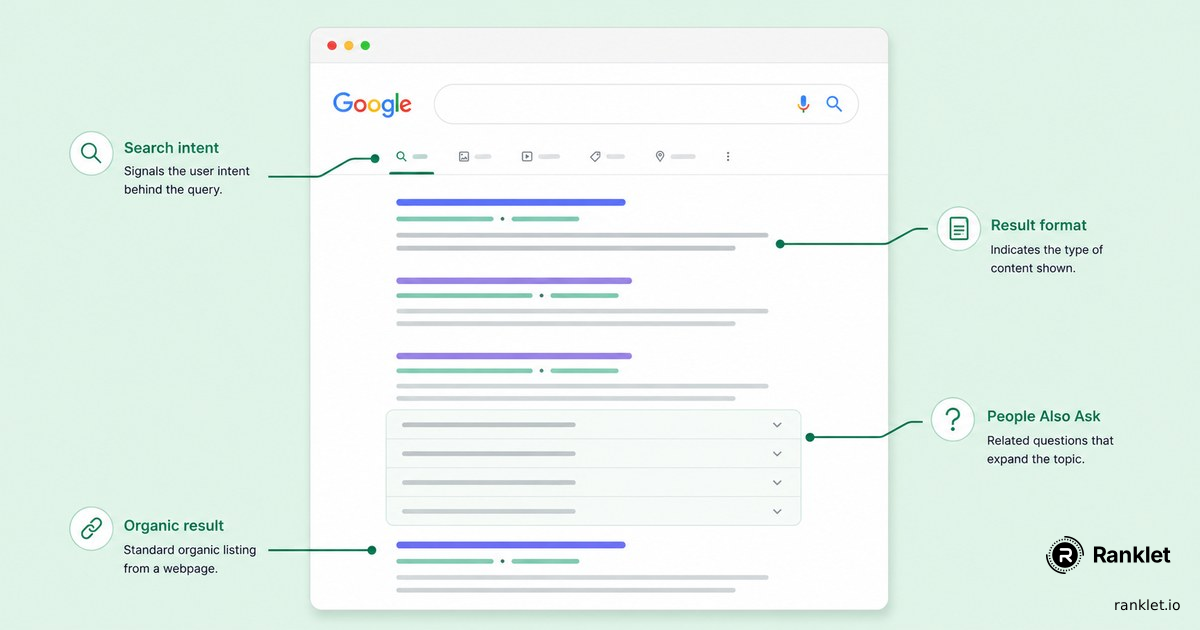
What Is SERP Analysis (And Why It Shapes Every Brief)
SERP analysis tells you what Google thinks ranks for your keyword. Here's what it covers, why most briefs skip it, and how to do it without a pricey suite.

Why Most Comprehensive Guides Don't Rank Anymore
The 10,000-word comprehensive guide playbook stopped working. Here's what changed in the SERPs and what actually gets pages ranked now.

Information Gain: The Real Reason Guides Don't Rank
Information gain is the signal behind why another 3,000-word guide won't rank. Here's what it is, how Google approximates it, and how to brief for it.