Information Gain: The Real Reason Guides Don't Rank

You research a keyword, read the top ten, and write a piece that covers everything they cover, plus a bit more. It’s thorough. It’s well-structured. It’s 3,000 words. And it lands on page three and stays there.
This happens constantly, and the usual explanations (domain authority, backlinks, Google being unfair) are mostly cope. The real reason is quieter and more fixable. Your page repeated what was already ranking. It had almost no information gain. To a system that has already read the other nine results, a tenth page that says the same things in a new order is not worth promoting, no matter how clean it is. That’s the fate of most published pages: an Ahrefs study of around 14 billion pages found that 96.55% of content gets no traffic from Google at all.
What information gain actually means
Information gain is the amount of new, useful information a page adds relative to what’s already available for that query. Not new to you. New to the results set. If a searcher has read the current top results, does your page tell them anything they didn’t already have? That delta is the thing.
It’s easy to confuse with quality, but they’re different. A page can be high quality and add nothing, which is most “ultimate guides.” A page can be rough around the edges and add a lot, which is most genuinely useful forum answers. Google is not grading your prose. It’s asking whether ranking your page would give searchers something the SERP doesn’t already give them.
This is also the missing half of the “just be comprehensive” advice everyone repeats. Comprehensiveness tells you to cover the topic. Information gain tells you to cover the part of the topic nobody else covered. Those are not the same instruction, and I’d argue comprehensiveness is why most guides fail, because it pushes writers to re-cover the settled ground at length instead of finding the gap.
Google patented a version of this
You don’t have to take the concept on faith. Google holds a patent, US 11,354,342, “Contextual estimation of link information gain”, granted in June 2022, describing how a search system can score documents by “information gain,” ranking a second document higher when it contains information a user hasn’t already seen in a document they read first. The patent frames it around a session: you’ve read one result, so the next result is more valuable if it adds something rather than repeating.
A patent is not a confirmed ranking factor, and I want to be careful not to overstate it. But it lines up with what anyone who publishes has watched happen. The near-duplicate tenth guide doesn’t move. The page with one section nobody else wrote climbs. Whether the mechanism is literally the patented method or something adjacent, the behaviour is the same, and it’s the behaviour you’re optimising against.
Why comprehensive stopped being enough
For years the winning move was to write the longest, most complete thing. It worked because most results were thin, so “cover everything” was itself a form of information gain. You were adding the sections the others skipped.
That arbitrage is gone. The top ten for any commercial keyword are now all comprehensive. Everyone read the same advice and wrote the same 3,000 words, and the near-duplicate is now cheaper than ever to produce: an Ahrefs study of 900,000 new web pages from April 2025 found that 74.2% contained AI-generated content. When every result already covers everything, covering everything adds nothing. The floor became the ceiling. The only way to add information now is to add the specific things the comprehensive pages still don’t have, which are almost always the things that are hard to fake: first-hand experience, original numbers, a genuinely different take, the edge cases people hit in practice.
How to find the gap in a live SERP
You can’t add what’s missing until you know what’s already there. This is a reading job before it’s a writing job, and it’s the same close reading behind good SERP analysis.
Open the current top ten and read them the way an editor reads submissions, not the way a fan reads. For each one, write down what it actually contributes, not its outline. Most will contribute the same four or five things. That overlap is the settled ground. You get no credit for re-covering it, so in your piece it becomes the short, corroborated section that establishes you know the basics, and then you move on.
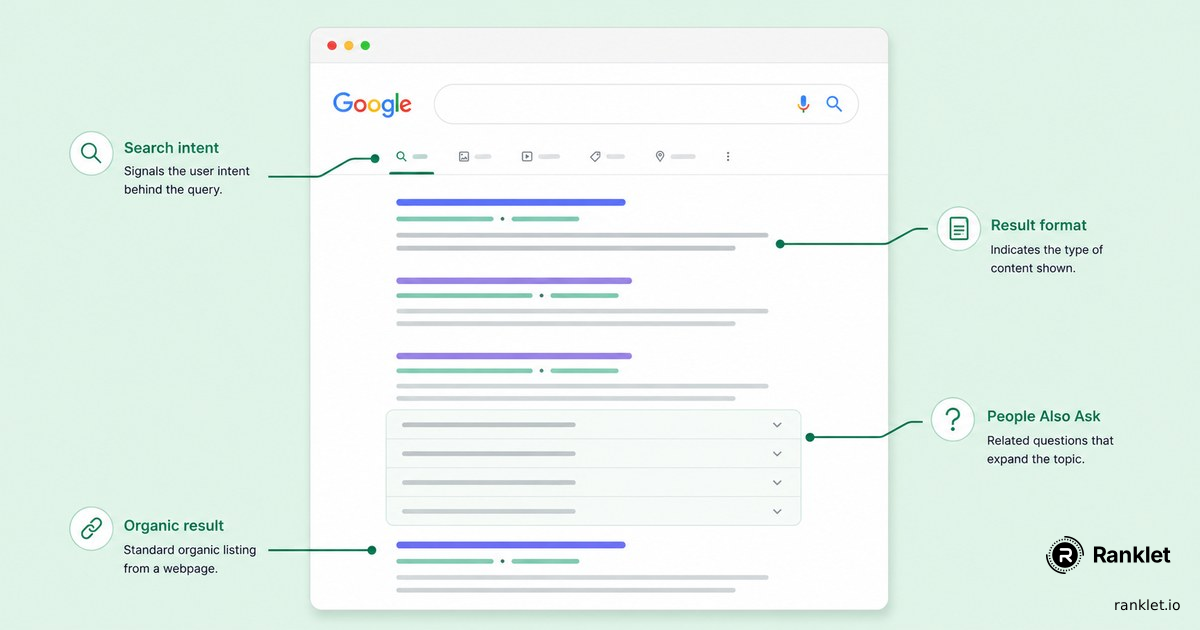
Then look for the holes. Read the People Also Ask cluster and the related searches for questions none of the top pages answer well. Notice the claims everyone asserts but nobody demonstrates. Notice where every page goes vague at the same spot, usually because none of the writers had done the thing. Those holes are your information gain. That’s where the piece earns its ranking.
Briefing for information gain, section by section
Information gain falls apart at the brief stage, because most briefs are built to guarantee coverage. They list the sections the top results have and tell the writer to include them. Follow that brief and you produce the near-duplicate by design.
A better brief marks two kinds of sections. Coverage sections are the settled ground: write them tight, get them corroborated, don’t pad them. Gain sections are the reason the page exists: the original example, the counter-argument, the data, the step everyone skips. The brief should say which is which, and it should protect the word count for the gain sections instead of letting the writer spend it re-explaining what a content brief is for the thousandth time. The research on AI answers points the same way: in the Princeton-led GEO study, methods like adding statistics, quotations and cited sources boosted a page’s visibility in generative engine responses by up to 40%, and those are exactly the things a gain section carries.
The one-line instruction that changes the most is per section: “everyone covers this, so keep it to a paragraph,” versus “nobody covers this well, so this is where you go deep and specific.” A writer who knows which sections are supposed to add something writes a different article than one told to be thorough. Pairing that with per-section intent, the way good briefs handle intent, is most of what separates a page that ranks from a page that’s merely complete.
The trap: gain for its own sake
There’s a failure mode on the other side. Once people hear “add something new,” some start adding new things that nobody asked for. A section on the history of the concept. A tangent about a related tool. Novelty that’s genuinely novel and genuinely useless.
Information gain only counts if it’s gain a searcher for that query actually wants. The test is whether the new material helps the person who typed the keyword, not whether it’s technically absent from the other results. A recipe page doesn’t rank better because it added the etymology of the dish. It ranks better because it added the one substitution note that every other recipe left out. Useful and new. Not just new.
A worked example
Take “how to write a content brief.” The top ten all define a brief, list its components, and give a template. That’s the settled ground. Writing a better version of that list gets you nowhere, because there are already nine good versions of it.
The gain is in what they skip. None of them show a real brief being handed to a writer and what the writer produced from it. None of them talk about the sections a brief should keep short on purpose. None of them address what changes when the writer is an AI instead of a person. Pick one of those, do it properly with a concrete example, and you’ve written the tenth result that’s worth ranking, because it’s the only one that adds the thing.
This is the logic behind how we build briefs at Ranklet. The tool reads the live top ten for your keyword, shows you what they already cover so you don’t waste the page re-covering it, and surfaces the People Also Ask and related questions the ranking pages leave unanswered, so the gap is visible before you write. It’s also the durable version of getting cited in the answer box, since the same original depth is what earns a click after someone reads an AI Overview. You can try it on one of your own keywords for free.
The next time a thorough piece won’t move, don’t add more words. Read the results, find the thing none of them say, and say that.
Questions that keep coming up
Is information gain a confirmed Google ranking factor?
No. Google has a patent describing it and has never confirmed it as a live ranking signal. Treat it as a useful model of what Google rewards rather than a dial you can read. The behaviour it predicts, that the near-duplicate tenth guide stalls while the page with one original section climbs, is what most publishers already see.
How do you measure information gain on your own page?
There’s no public score, so measure it by hand. List what each of the current top results contributes, mark the overlap as settled ground, and count the sections on your page that aren’t on that list. If the answer is zero, the page has no gain, however long it is.
Can AI-written content have information gain?
Not by default. A model drafting from what’s already published recombines the settled ground, which is the opposite of gain. AI can help with the coverage sections; the gain sections need something only you have: a real example, your own numbers, a tested opinion.
How much of a page needs to be new?
Less than people think. One properly developed section nobody else wrote can carry a page, as long as the coverage sections around it are tight and accurate. What fails is the reverse: a long page where every section is the same material in a new order.
Related reading

Why Most Comprehensive Guides Don't Rank Anymore
The 10,000-word comprehensive guide playbook stopped working. Here's what changed in the SERPs and what actually gets pages ranked now.
What Is SERP Analysis (And Why It Shapes Every Brief)
SERP analysis tells you what Google thinks ranks for your keyword. Here's what it covers, why most briefs skip it, and how to do it without a pricey suite.

Search Intent: The Part Most Briefs Get Wrong
Most briefs label intent and move on. Here's why that's backwards, and how matching intent at the section level is what actually moves rankings.