We Ran Our Own Citability Audit. Here's the Score.

We ran Ranklet’s Citability Audit on our own site on 19 October 2026. The home page scored 40 out of 100 and most blog posts 45, mainly for missing sourced statistics and source links. Fixes made the same day took the home page and five pillar posts to 100. Our new sample brief pages score 93, and seven older posts still sit between 23 and 45.
This post shows the scores for every page, what we changed, two claims of our own we had to correct along the way, and what still fails. We sell this audit, so it seemed fair to publish our own result before asking anyone else to run it.
How the score works
The audit reads a live page the way a crawler receives it and runs ten checks, each worth a fixed share of 100 points. Two more are reported but score nothing.
| Check | Points |
|---|---|
| At least 3 attributed statistics | 22 |
| Answer-first opening | 20 |
| Outbound links to sources | 14 |
| FAQ section with 4–6 questions | 12 |
| AI crawlers allowed | 8 |
| Headings match the brief’s questions | 7 |
| Content in the server-rendered HTML | 6 |
| Comparison table (comparison keywords only) | 5 |
| Visible last-updated date | 5 |
| HTTPS | 1 |
| FAQ schema, llms.txt | reported, 0 |
Evidence carries the most weight on purpose. In the Princeton-led GEO study, methods like adding statistics and citing sources raised a page’s visibility in generative engine responses by up to 40%, more than any change to wording or keywords.
Two checks depend on a brief: whether its questions appear as headings, and whether a comparison keyword gets a comparison table. Our home page and blog posts have no brief behind them, so we scored them with the same code minus those two checks. Our sample brief pages were audited in the product, each against its own brief.
Where we started
The surprise was where the points went. The three fixes every AI-search checklist leads with were already in place: robots.txt let every AI crawler in, we had an llms.txt file, and the home page had FAQ schema. Not one page lost a point on them.
The points went on content:
- Thirteen of 15 pages had no attributed statistic at all and one had a single figure, short of the three the check asks for: 22 points gone.
- Fourteen pages linked out to no source at all, another 14 points.
- Most posts had no question headings, so the FAQ check failed too.
- Four posts opened without a specific, checkable anchor.
- The home page had eight FAQ questions, two more than the 4–6 our own audit asks for, and no last-updated date.
| Page | Before | After |
|---|---|---|
| Home page | 40 | 100 |
| How to write an SEO content brief | 45 | 100 |
| What is SERP analysis | 45 | 100 |
| How to show up in Google AI Overviews | 45 | 100 |
| Information gain SEO | 45 | 100 |
| AI content briefs: where they help | 45 | 100 |
| Why your content isn’t showing up in AI search | 100 | 100 |
| Seven other posts | 23–45 | 23–45 |
| Blog index | 23 | 23 |
The one post that already scored 100 was the most recent, written after the audit existed. Everything older was written the way most content is: confident, well structured, and almost entirely unsourced.
What we changed
For the home page and the five pillar posts we changed four things:
- Sourced figures. Each page got at least three statistics with the source named in the sentence and linked. We opened every source before quoting it, which is how we found the two errors below.
- Question sections. Each post got four questions people actually ask about the topic, answered in a few sentences. On the home page we merged the FAQ from eight questions to six instead.
- Readable structure. The home page FAQ answers sat in a block the statistics check doesn’t read as body text, so they now render as paragraphs. The home page also got a modified date in its structured data.
- Housekeeping. robots.txt now names the AI crawlers in their own group, and llms.txt is generated from the site so it can’t fall behind. Neither moved the score; both were cheap.
Two claims we had to correct
Checking sources for our own posts turned up two figures we’d got wrong.
Our AI Overviews post said the box “now appears on roughly a quarter of searches”. We had no source for that. The best data we found, a Pew Research Center study of 68,879 Google searches, found an AI summary on 18% of them. The post now says 18% and links the study.
The same post called ranking “the entry ticket” for being cited. That was true when an earlier Ahrefs study found about 76% of AI Overview citations came from Google’s top 10. Their updated study of 863,000 keyword results puts it at 38%, likely because the model now searches sub-questions of its own. The post now says ranking helps but isn’t the whole ticket.
Why our own sample pages score 93
We also published five sample briefs: real, unedited Ranklet output with our notes on each. Audited in the product against their own briefs, all five score 93 and fail the same check.
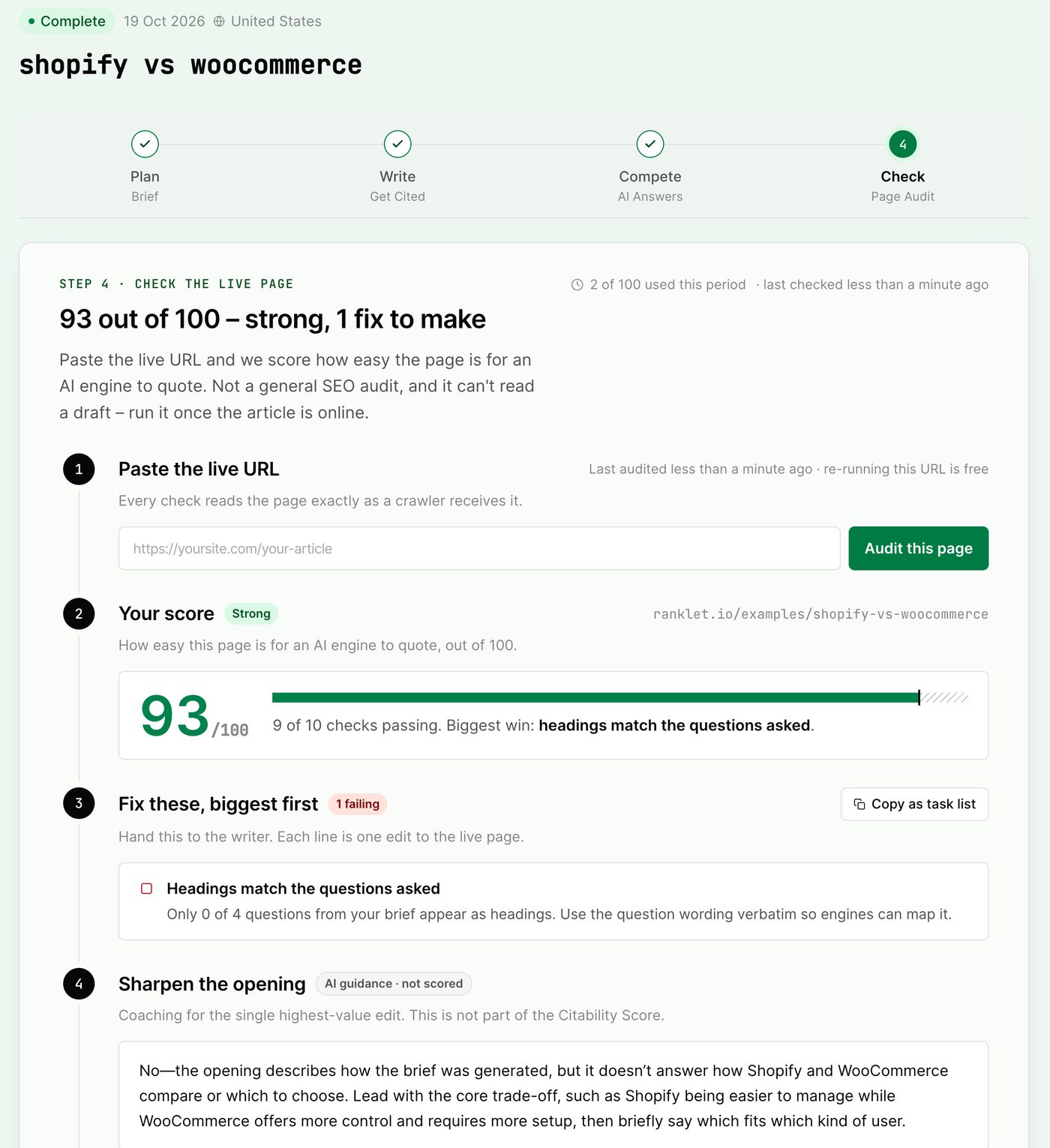
The failing check asks whether the brief’s questions appear as headings, and on these pages they don’t: zero of four. That’s correct. Each page is about a brief, not an article answering the brief’s questions, so the questions appear in the brief panel rather than as headings. The cold email page shows the same result with one check fewer, because only comparison keywords get the comparison table check.
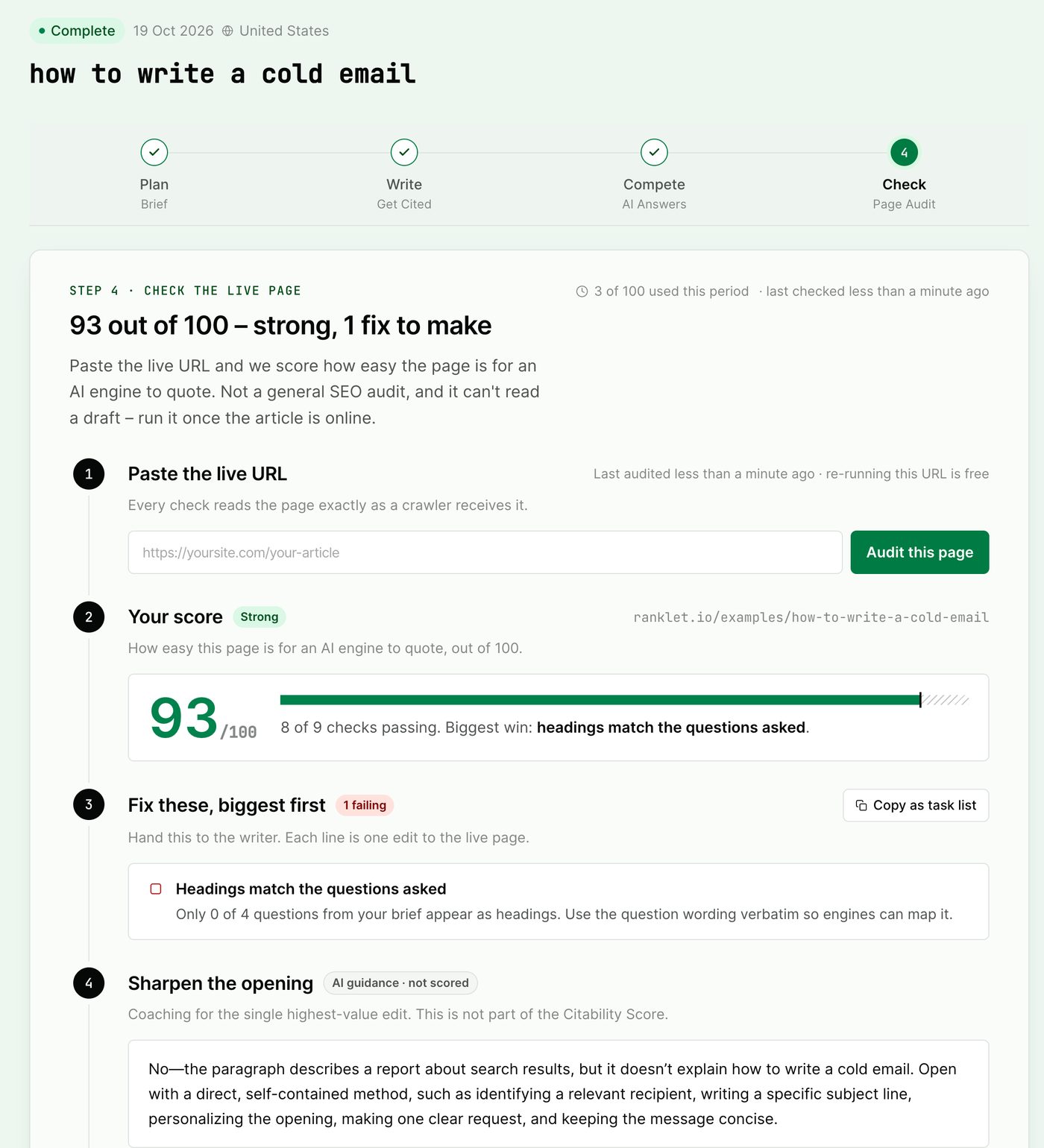
The AI coaching under the score makes the same point about the opening: it describes the brief rather than explaining how to write a cold email. Also correct, and also by design. We could reach 100 by adding two of each brief’s questions as headings, but that would be writing the page for the audit instead of the reader, which is the habit the audit exists to catch.
What still fails
Seven older posts still score between 23 and 45, the blog index scores 23, and the sample briefs index scores 40. They fail for the same reasons the pillar posts did: no sourced figures, no outbound links, no question headings. They’re next, one at a time, with every source opened before it’s quoted.
If you want to see how this goes on your own pages, the same audit is part of every Ranklet brief, and the Free plan includes one.
Questions that keep coming up
How long did the fixes take?
One day, 19 October, for the home page and five posts. Most of that went on finding and opening sources rather than writing. Adding a statistic is quick; confirming that the figure says what the page claims, and is still current, is the slow part.
Does llms.txt help you get cited?
Not measurably yet. Ahrefs looked at server logs from 137,210 domains in May 2026 and found that 97% of sites with a valid llms.txt file received no requests for it at all. We keep ours because generating it costs nothing, but our audit reports it without scoring it.
Is FAQ schema still worth adding?
Not for the rich result. Google’s FAQ structured data documentation records that the FAQ rich result stopped appearing in Search on 7 May 2026. The questions themselves still matter, because an engine can match a question heading to a passage, which is why the audit scores the FAQ section and not the markup.
Can I run the same audit on my own pages?
Yes. It’s the Page Audit step on every Ranklet brief: paste a live URL and you get the score, the checks that failed, and the fix for each. Re-auditing the same page after an edit is free, so you can watch the score move as you fix it.
Related reading
Why Your Content Isn't Showing Up in AI Search
Your page ranks but no AI cites it. What actually blocks AI search visibility, and why the llms.txt and schema fixes everyone recommends don't hold up.

How to Show Up in Google AI Overviews
AI Overviews now sit above the results on nearly one search in five. Here's what gets your content pulled into one, and why chasing the box is a mistake.

Information Gain: The Real Reason Guides Don't Rank
Information gain is the signal behind why another 3,000-word guide won't rank. Here's what it is, how Google approximates it, and how to brief for it.